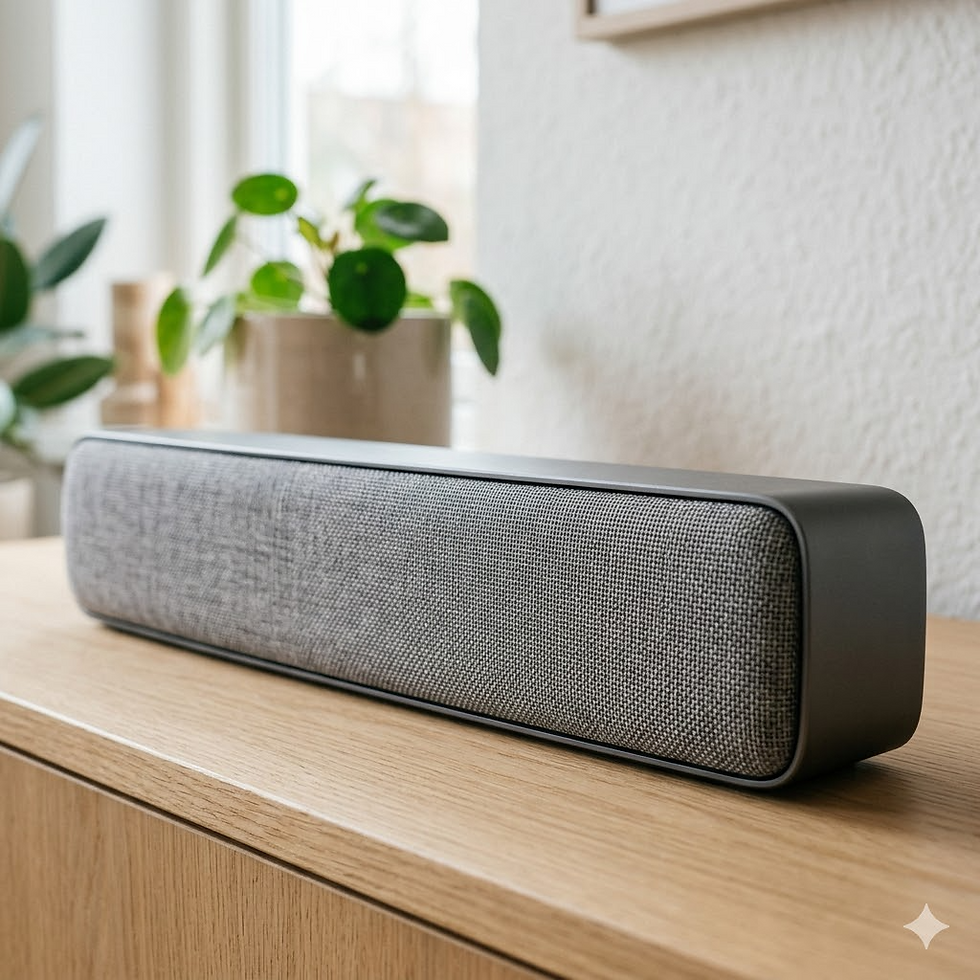
5 Technical Specs to Check Before You Specify Speaker Fabric
- luyingan
- Jun 17
- 3 min read
Updated: Jun 18

Choosing a speaker grille fabric looks simple from a distance — pick a color, confirm it stretches over the frame, done. In practice, the fabric sitting between a driver and a listener's ear is doing real acoustic and mechanical work, and the wrong choice shows up later as a returned unit, a warped grille, or a fabric that fades before the product's warranty period ends. Below are five specs worth confirming before a fabric gets locked into a bill of materials.
Acoustic Transparency
This is the spec that exists for one reason: the fabric has to let sound pass through with as little interference as possible. Weave density, yarn thickness, and finish all affect how much high-frequency energy gets absorbed or scattered before it reaches the listener. A fabric that looks identical to another on a swatch card can behave very differently once it's stretched across a driver, which is why acoustic transparency should be tested on the actual grille assembly, not just judged by eye. Open, evenly structured weaves — like the kind used in RC Textile's spun polyester range (rctex.com/spun) — are built specifically to stay out of the sound's way.
Colorfastness and Double-Dyed Construction
Speaker fabric lives in product categories — soundbars, smart speakers, car audio — where the unit sits in direct sunlight, near heat sources, or simply gets handled for years. Single-dye processes can leave color sitting mostly on the yarn surface, which fades unevenly as the surface wears. Double-dyed construction pushes color further into the fiber, giving the fabric more consistent color retention over the product's life and a more uniform look batch to batch. For brands shipping the same SKU across multiple production runs, this consistency matters as much as the initial color match. RC Textile's double-dyed line (rctex.com/double-dyed) was developed around exactly this requirement.
Stretch, Recovery, and Seamless Grilles
Anyone who has seen a grille fabric sag, pucker, or show a visible seam line after assembly has seen a stretch-and-recovery problem. The fabric needs enough elasticity to wrap curved or cylindrical enclosures cleanly, and it needs to recover its shape afterward rather than staying permanently deformed where it was pulled. This is especially relevant for cylindrical and portable speaker designs, where a seam is both a cosmetic flaw and a potential acoustic leak point. Seamless tube construction (rctex.com/seamless-tubes) removes the seam question entirely by knitting the fabric as a continuous tube sized to the enclosure, which is worth evaluating early if the product's industrial design includes curved or cylindrical surfaces.
Durability and Protective Finishes
Grille fabric takes more physical abuse than most people assume — fingertips, pet claws, dust, spilled liquids near outdoor and portable units. Specifying a fabric with a protective finish, rather than relying on the base weave alone, shifts the durability conversation from "how delicate is this" to "how does it perform under real-world handling." RC Textile's Durable & Protect line (rctex.com/durable-protect) is built around stain and abrasion resistance for exactly these use cases, which can matter more for outdoor and rugged product lines than for a living-room soundbar.
Pattern and Customization Options
Acoustic and durability specs get a product through engineering review; pattern and color are what get it through brand review. Custom weave patterns, textures, and color combinations let a fabric carry brand identity without compromising the acoustic and mechanical specs above — but they need to be evaluated together, not separately, since a striking pattern that fails an acoustic transparency test is not actually usable. RC Textile's patterns collection (rctex.com/patterns) and melange texture range (rctex.com/melange) are designed to give design teams that customization within fabrics that have already been engineered to the acoustic and durability baseline.
Building the Spec Sheet
None of these five specs work in isolation — a fabric that passes acoustic transparency testing but fails colorfastness will still generate field complaints, just on a longer timeline. The practical approach is to treat all five as a single checklist during fabric selection rather than optimizing for the one spec that's easiest to test early (usually look and feel) and hoping the rest holds up.
RC Textile has been manufacturing speaker fabric for OEM and ODM audio brands since 1969, supplying clients including Sony, Bose, Samsung, Sonos, and Harman. If you're specifying fabric for an upcoming product and want samples or technical data sheets against any of the specs above, visit rctex.com to explore the full product range and get in touch with our team.